
Hanoi aims for very high growth in the latter half of 2026.
At the Hanoi Capital Economic Forum 2026 held on the afternoon of July 31st, Mr. Cu Ngoc Trang, Director of the Hanoi Department of Science and Technology, stated that in the first six months of 2026, Hanoi’s GRDP increased by 8.22%, the highest growth rate in many years.
In addition, total retail sales and consumer service revenue reached VND 516.9 trillion, an increase of 13.3%; nearly 19,000 new businesses were established, an increase of 21% compared to the same period. However, Mr. Trang stated that to achieve double-digit growth, the GRDP growth rate for the last six months of the year needs to reach 13.44%. That is the first gap the capital city is determined to close.
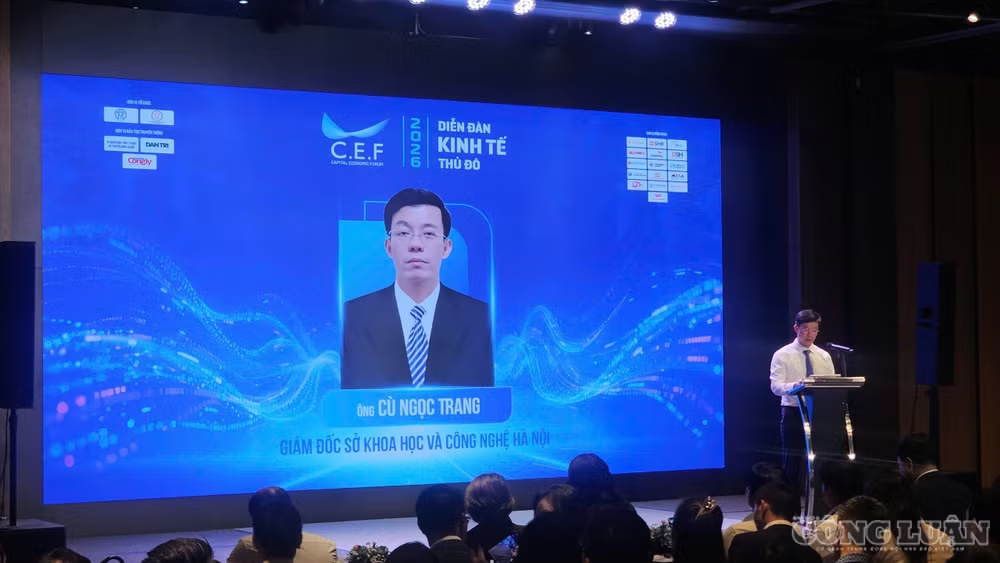
Mr. Cu Ngoc Trang, Director of the Hanoi Department of Science and Technology. Photo: Viet Vu
In that spirit, Hanoi aims to increase the proportion of digital economy’s added value in its GRDP to 22% in 2026. The first six months have already reached 16.7%, meaning it must surpass 26% in the last six months. This is the second gap that the business community needs to bridge together.
According to him, if Hanoi wants to achieve double-digit growth, it can only do so by focusing on individual businesses, starting with small and medium-sized enterprises (SMEs) also achieving double-digit growth.
And to achieve this, science and technology and digital transformation will be inevitable trends. In fact, Hanoi currently has 221 science and technology enterprises, more than 1,000 innovative startups, and nearly 11,000 digital technology enterprises.
Thus, it can be seen that the supply of technology is considerable, and market demand is also very large. However, having technology does not necessarily mean there will be growth.
The bottleneck lies in the fact that many small and medium-sized enterprises (SMEs) want to undergo digital transformation but don’t know where to start, and are concerned about costs and data risks. Many technology companies have good products but don’t fully understand the challenges faced by small businesses.
“Technology is on one side, the market is on the other; what’s missing is the connection in between,” Mr. Trang emphasized.
AI is not a “magic wand”.
Based on that, the Hanoi Department of Science and Technology has outlined five directions for action.
First, we should start with the business problem and use management innovation as the foundation.
Each business needs to identify the bottlenecks hindering growth: product/service quality, inventory, cash flow, sales costs, order processing speed, customer retention, or market expansion. Only then can the appropriate technology be selected based on this specific problem.
AI, e-commerce, or any digital platform is not a “magic wand” if the data is incorrect and the processes remain unchanged. (Illustration: CDK Bureau)
“Because AI, e-commerce, or any digital platform is not a ‘magic wand,’ if the data is incorrect, processes remain unchanged, and the workforce is not trained, then technology will hardly be effective. To achieve genuine transformation, businesses need to simultaneously innovate processes and improve the capabilities of their team,” Mr. Trang said.
Secondly, integrate technology into production and expand markets. According to him, good technology is truly valuable when it solves real needs; a good product generates growth when it is accepted by the market.
Therefore, the central solution is to support commercialization, bringing more research results into production and business; and at the same time, to bring the business’s problems back to the task of commissioning research from research institutes, universities, and technology companies.
“In other words, we’re using the output of science and technology businesses as input for the digital economy,” said the head of the Department of Science and Technology.
Third, build a collaborative ecosystem. In that ecosystem: businesses identify the problem; technology companies provide solutions; banks and investment funds provide resources; associations facilitate connections; and government agencies remove bureaucratic obstacles.
Technology partners should not only provide accounts or software, but also support training, process standardization, and evaluation of effectiveness after small and medium-sized enterprises (SMEs) implement the technology.
Fourth, maximize the utilization of institutions and resources. The City People’s Council has passed 8 out of 8 resolutions implementing preferential and specific policies of the Capital City Law on science, technology, innovation, and digital transformation.
In this model, the city places businesses at the center, providing diverse levels of support, up to 100% of the costs for many initiatives.
Regarding digital transformation and e-commerce, Resolution No. 59/2026 of the City People’s Council establishes a voucher mechanism to support up to 70% of the costs for small and medium-sized enterprises, business households, and traditional craft villages to use digital platforms and services.
In addition, the Department of Science and Technology has mobilized technology companies and credit institutions to participate in supporting SMEs (small and medium-sized enterprises) to use many platforms at preferential rates and free of charge until the end of 2026.
Fifth, the entire system must get involved and work together. The Department of Science and Technology will coordinate with units according to their functions and tasks, especially the People’s Committees of communes and wards, to receive needs from the grassroots; classify them according to policies, technology, capital, data, market, and human resources; forward them to the correct contact and monitor the results.
Mr. Cu Ngoc Trang emphasized: A business using AI to shorten order processing time; a household business managing cash flow with a digital platform; a craft village gaining more customers through e-commerce; a research result being commercialized and becoming a productive force – each change may start very small. But when thousands of such changes occur simultaneously, they will create new productivity, new markets, and new momentum for the capital’s economy.
Source: https://congluan.vn/ha-noi-cong-nghe-co-san-dieu-con-thieu-la-nhip-noi-voi-doanh-nghiep-post355565.html